
Epoxy vs resin: the honest difference
The phrase epoxy vs resin sets up a contest that doesn't quite exist — epoxy is one kind of resin. What actually matters for furniture is which epoxy, mixed for what job, and cured how. Here is what we use and why.

Epoxy is a type of resin, not its rival
Resin is the broad family — any viscous compound that cures from liquid to solid. It includes polyester and polyurethane resins, the UV resins used in jewellery, and epoxy. So the popular framing of epoxy vs resin compares a member against its own family. The real difference between epoxy and resin is the difference between epoxy and the other resins it sits beside.
Epoxy is the one we build furniture from, and for good reason. It cures by a chemical reaction between a resin and a hardener mixed at a precise ratio — not by evaporation — so almost nothing is lost as it sets and it barely shrinks. Polyester resin, by contrast, is cheaper but shrinks more, smells strongly of styrene, and yellows readily. For a piece that has to stay flat, clear and bonded to wood for decades, epoxy's dimensional stability is the whole argument.
Casting resin vs coating epoxy: depth is everything
Side by side, the two epoxies pull in opposite directions — and only one of them is built for the depth furniture demands.
| Casting resin (deep pour) | Coating epoxy (surface) | |
|---|---|---|
| Pour depth per layer | Several centimetres in one body | A few millimetres at most |
| Working/cure time | Slow — many hours, then a long set | Fast — sets in a few hours |
| Heat on cure (exotherm) | Gentle, released slowly and safely | Sharp; overheats if poured deep |
| Clarity in thick sections | Stays optically clear | Yellows and clouds when poured thick |
| Best furniture use | Rivers, voids and solid cast slabs | Thin seal coats and top finishes |
Even within epoxy there are two distinct tools, and confusing them is the most common mistake we see. A coating epoxy (table-top or bar-top epoxy) is engineered for thin films — a few millimetres at most. It reacts fast and gives off heat as it cures. Pour it deep and that heat has nowhere to go: the pour overheats, yellows, cracks, even smokes.
Casting resin — also called deep pour epoxy — is formulated for the opposite. It is thinner, reacts slowly, and releases its heat gently over many hours, so it can be poured in layers of several centimetres without cooking itself. That slow reaction is exactly what a river channel or a solid cast slab needs.
- Coating epoxy — thin, fast, hot; for seal coats and finishes
- Casting / deep pour epoxy — thick, slow, cool; for rivers, voids and solid blocks
For the resin band in a river table, casting epoxy is the only honest choice.
Why deep-pour casting epoxy suits furniture
Good epoxy resin for furniture has to do three things at once: fill a deep cavity in a single body without trapped heat, bond permanently to oily, characterful hardwood, and stay optically clear so the colour reads true. Deep-pour casting epoxy is built for all three.
Our method leans on its strengths. We pigment a batch once and never repeat it, then pour it in a single uninterrupted session so there are no cold-join lines inside the resin. The pour is degassed under vacuum to pull out the micro-bubbles that cloud a deep cast, then left to cure for around three weeks before the first cut. Rushing the cure is how a slab ends up soft or rubbery underfoot.
Wood choice matters as much as resin choice — oily species like macassar ebony need the right sealing first. We cover that in the wood selection guide, and the trade-offs that move a quote in what a river table costs.
Is epoxy resin durable? Heat, UV and the honest limits
Yes — cured casting epoxy is genuinely durable: hard, water-resistant, dimensionally stable and, on furniture, expected to last for decades with reasonable care. But durable is not invincible, and good makers are clear about the limits.
- Heat — epoxy softens before it ever melts. A hot pan straight from the stove can dent or cloud the surface. Trivets are not optional; this is physics, not fragility.
- UV / yellowing — epoxy yellows under sustained sunlight. Quality casting resins carry UV stabilisers that slow it dramatically, but no resin is fully UV-proof. We factor placement and tint into the design.
- Scratching — the surface can scuff, which is also why it can be refinished rather than replaced.
Knowing these limits is what lets a piece age well. We set out the day-to-day routine in resin table care.
Food contact, finishing and the surface you actually touch
Once fully cured, quality epoxy is inert and food-safe for incidental contact — a cheese board set down, a glass that sweats. That is not the same as a certified food-preparation surface, so we don't cut directly on the resin or treat it as a chopping board.
What you feel under your hand is rarely the bare casting. After the cast is cut flat and levelled, we finish it: either a hand-rubbed oil that sinks into the wood and leaves a soft, matte, repairable surface, or a lacquer for a harder, glassier sheen. The finish governs the look, the touch and how easily the piece is maintained over the years — so we choose it for the room the piece is going into, not by default.
If you're weighing a specific order, the clearest next step is to tell us about the piece and we'll talk material choices through with you.
From the catalogue
Pieces from the atelier in this direction — each made to order, each with its own page.

Levante
Two seas in a single deep pour — turquoise into gold.
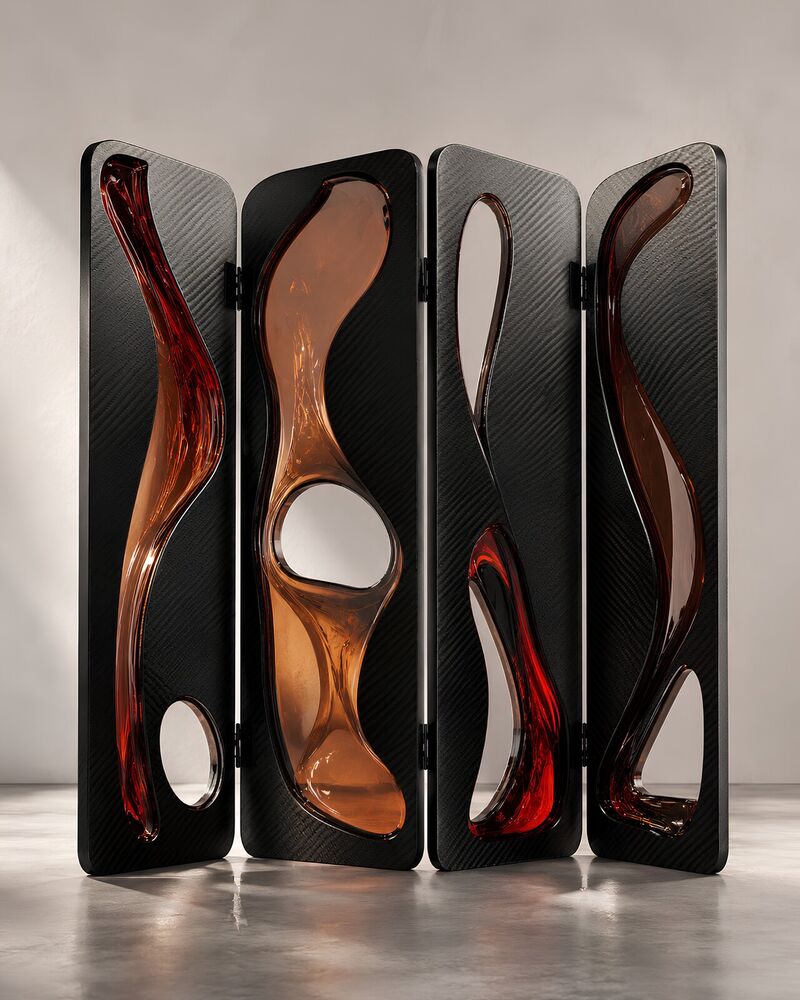
Vanta
Amber cast resin in woven twill — four panels, four kilograms.
See the catalogue → · Each piece is one of a kind, priced on request — the honest cost breakdown is in what a river table costs.
Common questions
What is the difference between epoxy and resin?
Resin is the broad family of liquid compounds that cure to a solid; epoxy is one type within it, alongside polyester and polyurethane resins. Epoxy is favoured for furniture because it shrinks very little, bonds strongly to wood, and stays clearer for longer than cheaper polyester resin.
Is epoxy a resin?
Yes. Epoxy is a specific kind of resin, defined by curing through a reaction between a resin and a hardener rather than by evaporation. So epoxy vs resin isn't really a contest — it's choosing the right resin, and for furniture that's almost always epoxy.
What is deep pour epoxy and how is it different from regular epoxy?
Deep pour epoxy, also called casting resin, is formulated to be poured in thick layers of several centimetres. It reacts slowly and releases curing heat gently, so it won't overheat and crack the way thin coating epoxy does when poured deep.
Is epoxy resin durable enough for a dining table?
Cured casting epoxy is hard, water-resistant and stable enough to last decades on a dining table. Its two real limits are heat — use trivets, as a hot pan can mark it — and prolonged direct sunlight, which can slowly yellow even UV-stabilised resin.
Is epoxy resin food safe?
Fully cured quality epoxy is inert and safe for incidental food contact, such as resting a plate or glass on it. It is not a certified food-preparation surface, so you shouldn't cut directly on the resin or use it as a chopping board.
Which resin is best for furniture?
Deep-pour casting epoxy. It fills deep cavities in a single body, bonds permanently to characterful hardwood, and stays optically clear so pigments read true — the three things furniture-grade resin has to do at once.
Order yours
Every piece we make is one of one — shaped around your space and a slab chosen for you. An order runs six to twelve weeks and begins with a conversation; we reply within two working days.
Start the conversation WhatsApp the atelier Email the studio See the catalogue