
The cast-resin kitchen island.
A cast-resin kitchen island is a built-in surface, not a table that happens to live in a kitchen — a continuous pour of tinted or clear resin and rare wood, formed as one and set into your joinery. ASK makes each one to order, often backlit, with edges that pour over the side, specified alongside your architect and your kitchen maker.

A built-in surface, not a freestanding table
A kitchen island top asks something different of cast resin than a dining table does. A table is an object — it stands on a base, you can move it, and it is complete in itself. An island top is architecture: it is fixed to cabinetry, it has to meet your joinery at a precise height, and it carries sinks, hobs, sockets and seating around its edges. We design and build it as a built-in surface from the first sketch, not as one of our freestanding resin tables resized to island proportions.
What carries across is the cast itself. The top is still a single body of resin and wood — burled walnut, olive, a pale figured slab — poured in one degassed session and cured slowly, so the surface reads as one continuous material rather than panels butted together. The difference is everything around it: the substrate it sits on, the cabinetry it returns into, the services that pass through it, all resolved before a drop is poured.
Backlit cast-resin islands
The island is where backlighting comes into its own. A translucent or tinted pour set over a concealed light source stops reflecting the room and begins to glow from within — the surface becomes the brightest object in the kitchen rather than a dark plane. We have built exactly this: a backlit turquoise cast-resin island, our Halcyon piece, where a clear Red Sea blue-green is lit from below so the resin reads as still, luminous water and the wood floats dark across it.
Backlighting changes how you choose colour, so we plan the two together. Translucent tints — turquoise, smoke grey, amber that turns to molten honey — come alive when lit; an opaque ink black or milk white cannot be backlit, because the pigment stops the light. Our guide to resin colours shows how each tint behaves with light passing through it. Where there is a window, we may light the island with daylight alone; where there is not, we build a sealed LED cavity into the cabinetry and coordinate it with your electrician.
Waterfall edges that pour over the side
A waterfall edge is where the surface turns ninety degrees and continues down the end of the island to the floor, so the grain and the resin run unbroken over the corner. It is the detail that most makes a cast-resin island look poured rather than built — a single material falling over the edge instead of a worktop sitting on a separate panel.
Done well, a waterfall is quiet engineering. The grain has to be matched across the mitre so it appears to flow round the corner; the resin seam has to be continuous; and the join has to be cut and bonded so the line nearly disappears. We can run a waterfall on one end or both, and detail the bottom return to meet your flooring cleanly. It is more work than a square edge, and we say so plainly — but on an island it is often the single detail that earns its keep.
Integrating with cabinetry and joinery
An island top is only as good as the box it sits on. A thick cast-resin surface is heavy, so the cabinetry beneath has to be built to carry it, level and true, with the overhangs supported where people will lean and sit. We work to the dimensions of your cabinetry — or, more often, we agree those dimensions with your kitchen maker before either of us builds, so the top and the joinery are designed to the same set of drawings.
- Seating overhang — where stools tuck under, the resin cantilevers past the cabinet. We size the slab and any concealed steel to carry that overhang without flex.
- Sinks and hobs — undermount sinks, drainer grooves and hob cut-outs are planned into the pour and the slab, not chased in afterwards.
- Sockets and services — pop-up sockets, charging points and cable routes are located on the drawing so nothing is improvised on site.
- Returns and end panels — the top meets cabinetry, walls and waterfall ends in details agreed in advance.
The same whole-flitch, live-edge thinking that runs through our furniture applies here — the difference is that an island is a coordinated build, with your joiner and ours working to one specification.
Honest durability in a working kitchen
A cured cast-resin surface is genuinely suited to a kitchen, and we would rather be precise about why than make it sound indestructible. On the things kitchens do most — water and spills — it is excellent. The resin is hard and non-porous, so it does not absorb water, wine, oil or citrus the way stone and bare timber can; around a sink it stays sound, and it wipes clean.
There are two honest limits, and both are easy to live with once known. Heat: resin is not stone. Use trivets and pan stands, and never set a pan straight off the hob or a dish straight from the oven onto the surface — direct, sustained heat can mark it. Knives: it is a worktop, not a chopping board; cut on a board, as you would on any fine surface. Beyond that, it can scratch under grit, and like all resins it can yellow under years of harsh direct UV, which is part of why placement and finish matter. None of this is fragility — it is simply a natural material that rewards a little care. Our care guide sets out the everyday routine, which is largely just a soft cloth and warm water.
How an island is specified — with your architect and joiner
An island rarely arrives as a single instruction; it is specified inside a project, often with an architect or kitchen designer leading and a joiner building the cabinetry. We are comfortable as the specialist surface-maker in that team. Every order begins with a conversation, and from there we work to drawings rather than promises.
We start from your plans, the cabinetry layout and the light in the room, then propose wood and resin and resolve the top as scaled drawings — dimensions, edge and waterfall details, cut-outs, overhangs and the lighting cavity. You approve those drawings, and a sample resin pour in your chosen tint, before anything is cast. We coordinate weights, fixing points and service locations with your joiner and electrician, working remotely by video, drawings and photographs where needed. Nothing structural is left to be discovered on site.
Lead time, delivery and installation
Lead time runs six to twelve weeks, and an island sits at the longer end because of its size and the coordination it needs. Much of that time is the cast itself: the timber has rested in the store for years, air-seasoned rather than kiln-dried, the resin is poured in one uninterrupted degassed session, and a thick pour cures for around three weeks before the first cut. We plan backwards from your install date so the surface is ready when the cabinetry is.
The island is made to order in Egypt and delivered worldwide — to private residences, hospitality projects and, with marine detailing, to yachts. Crating, shipping and on-site installation are arranged as part of the order and coordinated with your site access and your joiner's programme. If you are weighing the project, our notes on how to order and what to expect walk through the same steps we follow for an island. When you are ready, send us your plans and the light in the room, and we will reply within two working days.
From the catalogue
Pieces from the atelier in this direction — each made to order, each with its own page.
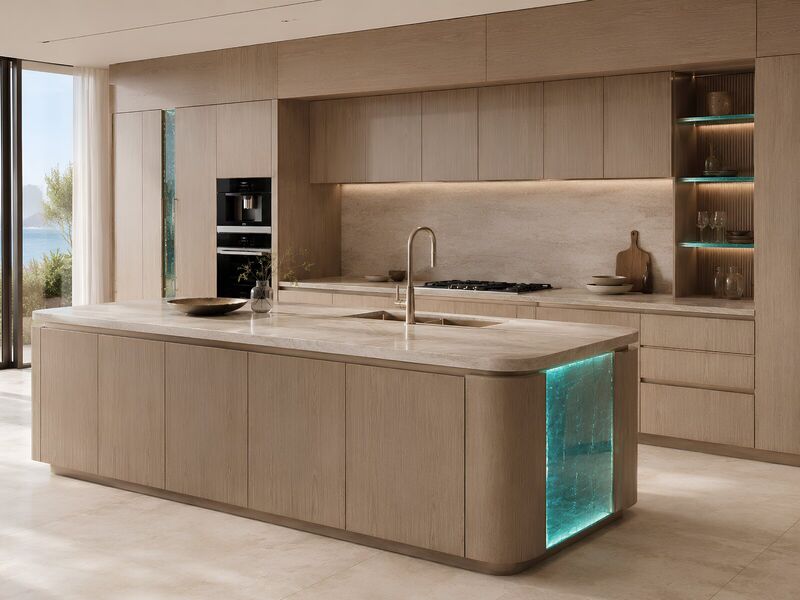 № 06 · Interior
Halcyon
A bespoke oak kitchen with a backlit turquoise cast-resin island — lit from within, on the Red Sea.
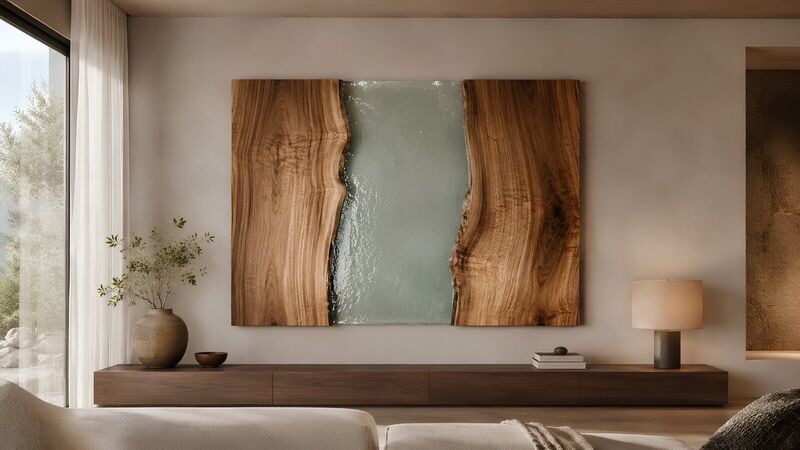 № 03 · Feature wall
Ondine
Walnut slabs and pale-green cast resin — a river, raised to the wall of an interior.
See the catalogue → · Each piece is one of a kind, priced on request — the honest cost breakdown is in what a river table costs.
Common questions
Can you make an epoxy resin kitchen island or countertop?
Yes — a built-in cast-resin island top or countertop is one of the things we make. It is poured as a single continuous body of tinted or clear resin and wood, then fixed into your cabinetry rather than standing as a freestanding table. We design it to your kitchen plans, with edges, cut-outs and overhangs resolved in drawings first.
Can a cast-resin island be backlit?
Yes. Any translucent or tinted pour can be backlit — set over a window or a concealed LED cavity built into the cabinetry — so the surface glows from within rather than reflecting the room. We have made a backlit turquoise island, our Halcyon piece. Opaque colours such as ink black cannot be lit through, since the pigment stops the light, so we plan the colour and the lighting together.
What is a waterfall edge on a resin countertop?
A waterfall edge is where the surface turns the corner and runs down the end of the island to the floor, so the grain and resin appear to pour unbroken over the side. The grain is matched across the mitre and the seam bonded so the line nearly disappears. It can run on one end or both, and it is the detail that most makes an island read as poured rather than assembled.
Is a resin countertop durable enough for a kitchen?
For the things kitchens do most it is excellent — the cured resin is hard and non-porous, so it shrugs off water, spills, wine and citrus and wipes clean, including around a sink. The honest limits are heat and knives: use trivets and never set a hot pan straight onto it, and cut on a board rather than the surface. With that ordinary care it lasts for decades.
How do you fit a cast-resin top to my cabinetry?
We work to your cabinetry dimensions, or agree them with your kitchen maker before either of us builds, so the top and the joinery share one set of drawings. Sink and hob cut-outs, seating overhangs, sockets and waterfall returns are all planned into the pour and the slab in advance. We coordinate weights and fixing points with your joiner and electrician so nothing is improvised on site.
Can you deliver and install a kitchen island worldwide?
Yes. Islands are made to order in Egypt and delivered worldwide, with crating, shipping and on-site installation arranged as part of the order and coordinated with your site access and joiner's programme. Lead time is six to twelve weeks, and we plan backwards from your install date so the surface is ready when the cabinetry is.
Order yours
Every island and countertop we make is one of one — drawn around your kitchen, your cabinetry and the run of the stone or wood, and cast for that space alone. An order runs six to twelve weeks and begins with a conversation; we reply within two working days.
Start the conversation WhatsApp the atelier Email the studio See the catalogue