
How much does a river table cost?
Ask how much a river table costs and the honest answer is: it depends on what's inside it. This guide walks the real variables behind river table price — so you can read a quote and know exactly what you're paying for.
In short: a river table's price is driven by size and resin volume, then by wood species and rarity, river style and finish, the base, and worldwide shipping. Common timber and a narrow seam sit at the calm end; rare burl and a broad river climb steeply. Each piece is quoted individually — built by hand, priced to the piece.

Why there's no single river table price
A river table is not a catalogue object with a sticker, so any honest answer to how much does a river table cost begins by naming the variables rather than inventing a number. Two tables of the same length can sit far apart on price because what's inside them — the slab, the resin volume, the figure of the wood — is entirely different.
Think of river table cost the way you'd think of a tailored suit: the bill follows the cloth, the cut and the hours, not a size on a rack. A modest console in a common timber with a narrow seam occupies the calm end of the range. A long, thick dining slab in rare burl, with a wide translucent river and a sculpted base, sits at the other. Most orders land between.
For a figure tied to your actual piece, the only reliable path is to request a quote — but first, here is what moves the meter.
Size and resin volume: the biggest lever
Before the detail, here is the whole picture at a glance — the five things that move a river table's price, and the direction each one pushes it.
| What changes the price | How it moves it |
|---|---|
| Size and resin volume | The biggest lever — a wider, thicker top needs more slab and a far larger single pour, and resin is bought by the kilo. |
| Wood species and rarity | Common, even-grained hardwoods sit low; scarce, highly figured flitches such as burled walnut, ziricote, macassar ebony and ancient olive climb steeply. |
| River style and finish | A clear, translucent river and a flawless hand-built polish ask more pigment work and more hours than an opaque pour and a simpler surface. |
| The base | A plain steel frame is economical; a sculpted, cantilevered or stone base is its own order. |
| Crating and worldwide shipping | A real, separate line that rises with the table's weight, your destination and final-metre access. |
Of everything that sets a river table cost, size and resin volume move it most — and the two are linked. A wider, longer river doesn't just need more square footage of wood; it needs a deeper, larger body of resin, and resin is poured by the kilo.
Volume compounds in ways that surprise people. A river twice as wide in a slab twice as thick can hold several times the resin, and we pour it in a single uninterrupted session — there is no topping up a river table the next day. That means buying enough material for the whole pour at once, degassing it under vacuum, and accepting a longer, riskier cure.
- Length and width — set the footprint and the wood you need.
- Thickness — a chunky 50–60mm top reads as a serious slab and multiplies resin depth.
- River width — a quiet seam costs far less to fill than a broad, table-dominating channel.
If budget is the constraint, this is the lever to pull first. See how a river table is made for why the pour can't be rushed.
Wood species and rarity
The slab is the soul of the table, and wood species and rarity are among the clearest drivers of price. We buy timber as whole flitches — the full sequence of boards from one trunk — and rest them for years before the first cut. That patience, and the rarity of the figure, is what you're paying for.
Common, even-grained hardwoods sit at the accessible end. Highly figured and scarce species — burled walnut, ziricote, macassar ebony, ancient olive — climb steeply, both because the raw flitch is dear and because matched, defect-free book-matched slabs are hard to win from any one trunk. A heavily burled or spalted board with dramatic movement is rarer still, and priced accordingly.
It's worth choosing here with intent rather than by budget alone: the wood decides the table's character for its whole life. Our guide to wood selection walks the species and what each one does beside a resin river, and live-edge slabs shows how we read a flitch.
River style, finish and the base
Two tables with identical slabs can still diverge on epoxy table price once you factor in how the river is made and how it's finished. A translucent, sea-glass river that shows the live edge through it asks for more careful pigment work and clarity than an opaque pour read as cut stone. Custom-mixed colour — pigments we blend once and never repeat — is bespoke by definition.
Finish is hours, not minutes. Sanding through every grit, then building oil or lacquer coat by coat until the wood reads deep and the river reads wet, is slow handwork that scales with surface area and with how flawless you want the polish.
- River style — clear, smoked or saturated; narrow seam or broad channel.
- Surface — dead-flat formal polish or a gently rippled, light-catching top.
- Base — a simple steel frame is economical; a sculpted, cantilevered or stone base is its own order.
For the difference behind the materials themselves, see epoxy vs resin.
Crating, worldwide shipping and lead time
A finished slab is heavy, fragile and irreplaceable, so crating and worldwide shipping are a real line on any river table cost — not an afterthought. We build bespoke crates around each piece and ship from Egypt to private residences, yachts and hospitality projects worldwide, which means freight, insurance and handling that vary with weight, destination and access.
A compact coffee table to a city apartment is a different proposition from a four-metre dining slab to an island villa or a vessel in dry dock. Final-metre access — stairs, lifts, narrow doors — can shape both the engineering and the delivery cost, which is why we ask about your space early.
Lead time is part of the value, not a delay: an order runs six to twelve weeks, governed by a roughly three-week cure that simply cannot be hurried. We reply to inquiries within two working days, and the conversation is where a real number takes shape.
What you're really paying for
Set against mass-produced furniture, a bespoke river table looks expensive until you account for what it is: a one-of-one object, made to order, that should outlast the room it's bought for. The river table price buys years of rested timber, a single flawless pour, weeks of curing and finishing, and a piece dimensioned for your space and no one else's.
Value here is measured over decades. A flat-pack table is replaced; a properly made resin slab is repaired, refinished and passed on — wood keeps breathing with the seasons while the resin holds it gracefully. With sensible care, the surface you order is the one your grandchildren inherit.
The most useful next step is not a number from a page but a number for your table. Tell us the room, the use and the feeling you're after, and we'll cost it honestly. Begin the conversation — or see what's possible in the catalogue.
From the catalogue
Pieces from the atelier in this direction — each made to order, each with its own page.
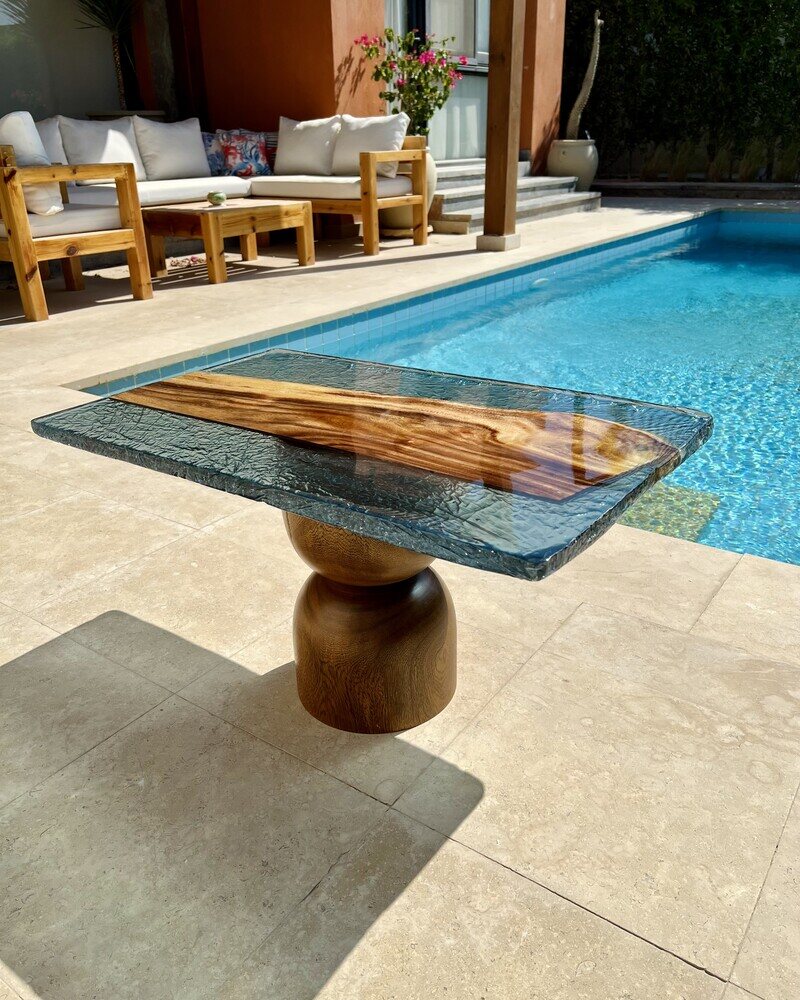
Strata
A single slab, held in still water — cast resin and walnut.
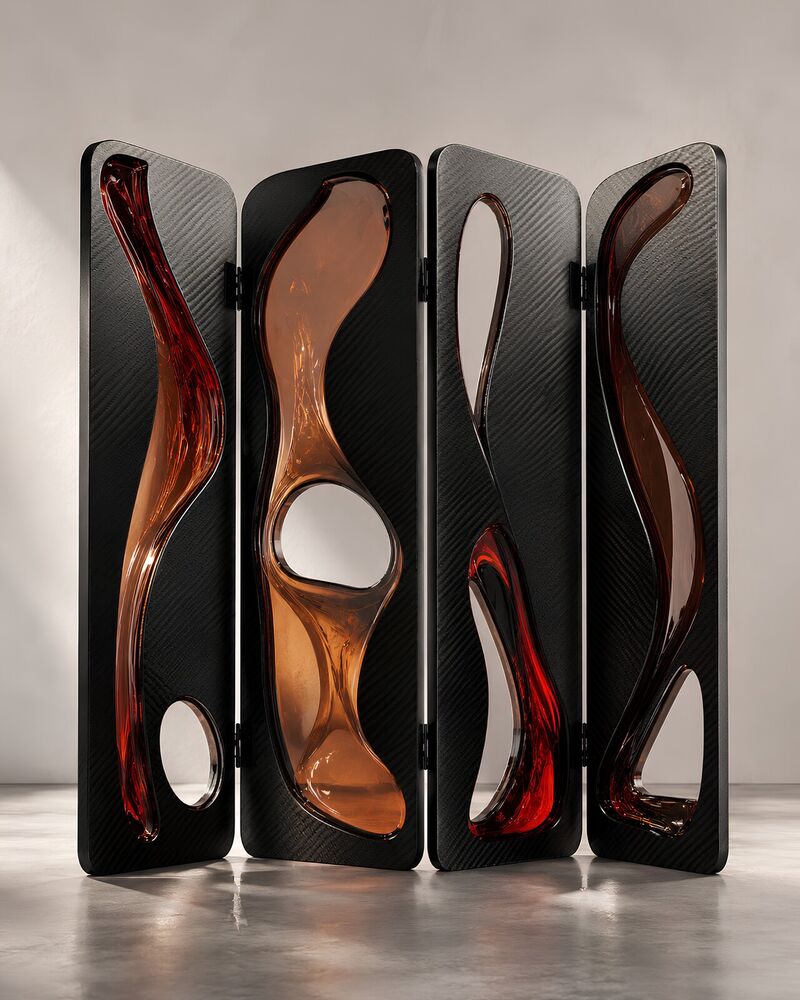
Vanta
Four panels of amber cast resin in woven twill.
See the catalogue → · Each piece is priced individually, on request — the drivers behind every quote are the ones explained on this page.
Common questions
How much does a river table cost on average?
There's no single figure, because price follows what's inside the table — size and resin volume, wood rarity, finish, base and shipping. A small console in common timber sits at the calm end of the range; a large dining slab in rare burl with a wide river sits far higher. The only accurate number is a quote for your specific piece.
What affects river table cost the most?
Size and resin volume move the price most, followed closely by wood species and rarity. After that come river style and finish, the base, and crating plus worldwide shipping. A wider, thicker top in a rare burled species with a broad translucent river is the most expensive combination.
Why are bespoke epoxy tables more expensive than store-bought furniture?
You're paying for whole flitches of timber rested for years, a single uninterrupted resin pour degassed under vacuum, a roughly three-week cure, and finishing built up by hand. Each table is one of one, dimensioned for your space, and made to be repaired and passed on rather than replaced.
Does the type of wood change the price of a river table?
Significantly. Common, even-grained hardwoods are the most affordable; scarce, highly figured species like burled walnut, ziricote, macassar ebony and ancient olive cost more because the raw flitch is dear and matched, defect-free slabs are hard to win from one trunk.
How long does a river table take to make?
An order runs six to twelve weeks. Much of that is the resin cure — roughly three weeks before the first cut — which cannot be rushed without risking the piece. We reply to inquiries within two working days.
Is worldwide shipping included in a river table price?
Crating and shipping are a separate, real cost that varies with the table's weight, your destination and final-metre access. We build bespoke crates and deliver from Egypt to homes, yachts and hospitality projects worldwide, and we factor this into your quote.
Order yours
Every piece we make is one of one — shaped around your space and a slab chosen for you. When you're ready to order a river table, an order runs six to twelve weeks and begins with a conversation; we reply within two working days. Current designs are in the catalogue, each quoted individually on request.