
Live edge furniture, cut around the figure
Live edge furniture keeps the tree's own outline — the bark-shaped contour of the trunk — as the finished edge of the piece. At ASK Studio we buy whole flitches and cut around the figure, never through it.

What "live edge" actually means
A live edge is the tree's own outline left intact. Instead of squaring a board to four straight sides, the maker keeps the natural edge wood — the undulating line where the trunk met its bark — as the visible edge of the finished piece. It is the difference between furniture cut from a tree and furniture that still remembers being one.
That single decision changes everything downstream. The edge dictates the silhouette, so the form is found in the slab rather than imposed on it. A bough scar, a fork in the trunk, a band of spalting — these stop being defects to mill away and become the reason the piece exists. A genuine live edge cannot be drawn in advance; it is read out of the wood. That is why no two pieces are the same, and why the species and the individual flitch matter more than any template.
Why we buy whole flitches, not single boards
A flitch is the complete sequence of slabs cut from one trunk, kept in order. Buying the whole flitch — rather than a board off a rack — is the part of the craft most makers skip, and it is the part that decides quality.
- Matched grain. Adjacent slabs mirror each other. For a book-matched top or a pair of consoles, the figure has to come from neighbours in the same trunk; it cannot be faked from two unrelated boards.
- Years of rest. We rest flitches in our store for years, not days, so the wood reaches a settled moisture content before the first cut. Rushed timber is what later cups, splits and twists.
- Cut around the figure. Owning the whole flitch lets us cut around the best burl, crotch and grain — never through it — and lose nothing to a supplier's standard dimensions.
It is slower and it ties up capital for years. It is also the only honest way to make a walnut slab table that holds its line for a lifetime.
The species we work in
Live edge rewards figured, stable hardwoods bought as whole flitches and rested. We work mainly in four:
- Burled walnut — swirling, knotted figure and warm chocolate tones; the classic choice for a live edge table where you want the grain to be the event.
- Ziricote — dramatic black landscape-grain on a brown ground; formal and architectural.
- Macassar ebony — fine dark-and-amber stripes that read like a pinstripe; quiet but unmistakably rare.
- Olive — pale gold with wild, restless figure; lively rather than sombre.
Each behaves differently under tool and oil, and each suits a different room. A live edge dining table in ziricote feels nothing like one in olive. We will guide the choice around your light, your space and how the piece will actually be used — not around what happens to be in stock.
Beyond tables: consoles, walls and screens
Live edge is a logic, not a single product. The same respect for the natural edge runs through pieces that never touch a dining room.
Consoles and benches take a narrow run of slab and let the live edge define a long, low silhouette against a wall. Feature walls compose several matched slabs into a single architectural surface — see Ondine, a walnut wall washed with pale-green resin. Pivot doors like Carmine carry a live edge through a working threshold, and folding screens such as Vanta set timber against woven panels.
Where a live edge meets a poured seam, the piece becomes a live edge river table — banks of natural-edge wood with a still river of resin between. For more on those, our feature walls and screens page covers the architectural work in depth. The slab is the starting point; the brief decides the rest.
Stability, movement and honesty
Solid wood is a living material, and we would rather explain that than pretend otherwise. A slab expands and contracts across its width with the seasons — measurably, every year, for the life of the piece. Good live edge furniture is engineered to let that happen without splitting.
In practice that means rested, acclimatised timber; breadboard ends, butterfly keys or sliding fixings that allow movement rather than fight it; and a finish — oil or lacquer, built up in coats — that slows moisture exchange and deepens the grain. Where a slab carries a sound natural check, we may stabilise it with an epoxy inlay; where it does not, we leave it be.
What we will not do is sell you a flawless illusion. A small colour shift, a tight knot, a faint line of figure where two growth phases met — these are the signature of real wood, and on a one-of-one piece they are the point, not the compromise.
From the catalogue
Pieces from the atelier in this direction — each made to order, each with its own page.
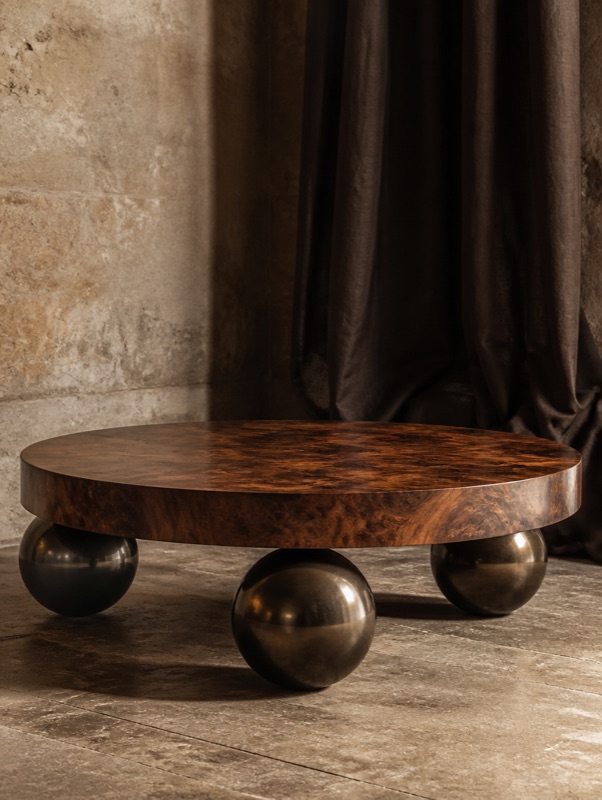 Burled walnut · Bronze
Atlas
A slab set down on three worlds.
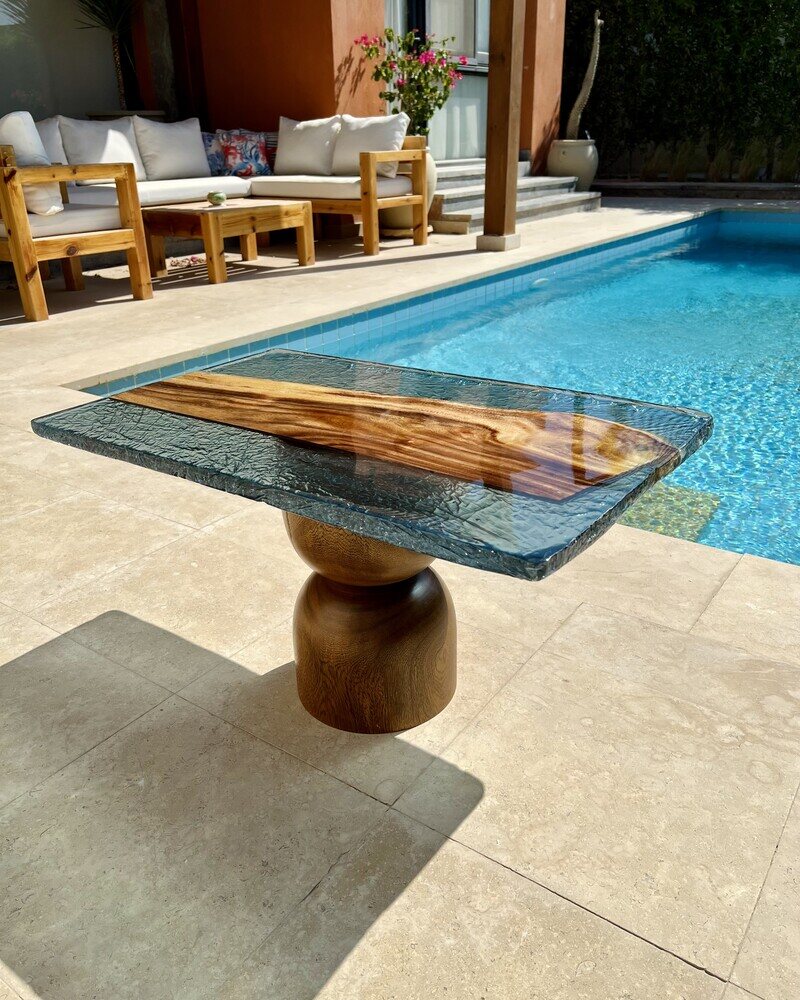 Cast resin · Walnut
Strata
A single slab, held in still water.
See the catalogue → · Each piece is one of a kind, priced on request — the honest cost breakdown is in what a river table costs.
Common questions
What is the difference between live edge and a normal table?
A live edge table keeps the tree's natural bark-shaped contour as its finished edge, rather than being squared off to four straight sides. It means the silhouette is found in the individual slab, so no two pieces are alike.
Is live edge furniture stable, or does it warp?
Properly made, it is very stable. Stability comes from resting and acclimatising the timber for years before cutting and from using fixings that let the wood move with the seasons rather than restraining it. Rushed, unseasoned slabs are what warp and split.
What is the best wood for a live edge slab table?
Figured, stable hardwoods are best — we favour burled walnut, ziricote, macassar ebony and olive. The right choice depends on your room and light; see our wood selection guide for how each species behaves.
Why does ASK buy whole flitches?
Buying the complete sequence of slabs from one trunk lets us book-match grain, rest the wood properly, and cut around the best figure instead of being limited to a supplier's standard boards. It is the foundation of a piece that holds its line for a lifetime.
Can you make live edge pieces other than tables?
Yes. The same approach produces consoles, benches, feature walls, pivot doors and folding screens. Where a live edge meets a poured resin seam it becomes a live edge river table.
Do you deliver live edge furniture outside Egypt?
Yes. Every piece is made to order in Egypt and delivered worldwide — to private residences, yachts and hospitality projects. Lead time is typically six to twelve weeks and we reply within two working days.
Order yours
Every piece we make is one of one — shaped around your space and a slab chosen for you. An order runs six to twelve weeks and begins with a conversation; we reply within two working days.
Start the conversation WhatsApp the atelier Email the studio See the catalogue