
The bespoke epoxy resin table
An epoxy resin table is rare wood and tinted resin cast as one piece — a single river or pour, degassed and cured slowly into a surface you use every day. ASK makes each one to order, around your wood, your colour and your room.

What a cast-resin table actually is
A cast-resin table marries a slab of solid wood with a body of clear or tinted epoxy poured around, between or over it. The resin is a two-part system — resin and hardener — that cures from a liquid into a hard, glass-clear solid through an irreversible chemical reaction. The wood is structure and grain; the resin is the still water, the colour, the light.
The most familiar form is the river table, where two live edges face each other across a vein of resin. But the same craft makes solid pours, full clear epoxy table tops that encase a single board, and slabs where resin fills only the wood's natural voids. What unites them is the cast: a wood and resin table is not assembled from parts but formed as one continuous piece. If you want the full mechanics, see river tables, explained.
Dining, coffee, console, desk, conference
The same method scales across a room. Each type asks something different of the wood and the pour, so we plan them as distinct orders rather than one design resized.
- Resin dining table — the centrepiece. Long flitches, a generous resin channel, and a base engineered to seat people without crowding the legs. See epoxy dining tables.
- Coffee and centre tables — lower, wider, more sculptural; the place a deep pour and a dramatic tint read best up close. See resin coffee tables.
- Console and desk — narrow, architectural surfaces for an entrance or a study, where a single clean edge does the work.
- Conference tables — boardroom-scale slabs, often book-matched, built for daily use and cable management.
Whole-flitch and live-edge work underpins all of them — more at live-edge furniture.
How ASK casts an epoxy table
The method is the same for every piece, and each stage is unhurried.
- Choose and rest the wood. We begin with rare woods bought as whole flitches — burled walnut, ziricote, macassar ebony, olive — and rested for years until they are stable.
- Wall it into a mould. When a piece is chosen, it is flattened, sealed, and walled into a mould ready for the pour.
- Tint and pour in one degassed session. The resin is tinted by hand, the pigment mixed once and never repeated, so your colour exists only in your table. We pour in a single uninterrupted session and degas the resin under vacuum, drawing out the air so the cured body is clear and free of bubbles.
- Cure slowly. Then it rests. A thick cast cures slowly — roughly three weeks — before the first cut, because rushing the exotherm risks cracks and cloudiness.
- Level, sand and finish. Only then do we level, sand through the grits, and finish in oil or lacquer coats.
Lead time runs 6–12 weeks. On the chemistry behind the choice, see epoxy vs resin.
Customising wood, resin, size and finish
Every custom resin table is configured with you across four decisions, and each one changes the others.
- Wood — species and figure set the character: the wild swirl of burl, the spider-web of ziricote, the calm of olive. Guidance at the best wood for a river table.
- Resin — clear to let the room through, or tinted: a smoke grey, a Red Sea turquoise, an amber that glows when backlit. Opacity is yours to set, and our guide to resin colours shows how each tint reads in the wood.
- Size and form — dimensions, edge treatment, and whether the resin runs as a river, a pool, or a full encasing top.
- Finish and base — a soft matte oil or a deep lacquer, on a base in steel, blackened metal or wood.
We work to your space and, for many clients, to a specific light. The piece is resolved in drawings before a drop of resin is poured.
Durability and everyday life
A cured epoxy surface is hard, non-porous and water-resistant — built to be lived on, not roped off. Spills wipe away; the resin does not absorb wine or oil the way bare wood can. With normal care a resin table holds its clarity and finish for decades.
Two honest limits are worth knowing. Epoxy is softer than glass, so it can scratch under grit or a dragged ceramic dish, and like all resins it can yellow under years of harsh direct UV — which is why placement matters and why we finish protectively. Heat is the other: use trivets, never a pan straight from the stove. None of this is fragile; it is simply a natural material that rewards a little attention. Full routine at resin table care.
What it costs, and how to order
No two orders price the same, because the cost lives in the drivers: the rarity and size of the flitch, the volume and tint of resin, the complexity of the form, the finish, and the base. A small clear-pour console and a four-metre dining river are different undertakings entirely. We quote each piece individually — the honest breakdown is at what a river table costs.
To order, send us your room, your rough dimensions, and any references for wood and colour — our note on what it costs and how to order walks through the steps. We reply within two working days, propose wood and resin, and resolve the design before casting. Pieces are made to order in Egypt and delivered worldwide, to private residences, yachts and hospitality projects alike. When you are ready, start the conversation — or see finished work in our catalogue.
From the catalogue
Pieces from the atelier in this direction — each made to order, each with its own page.
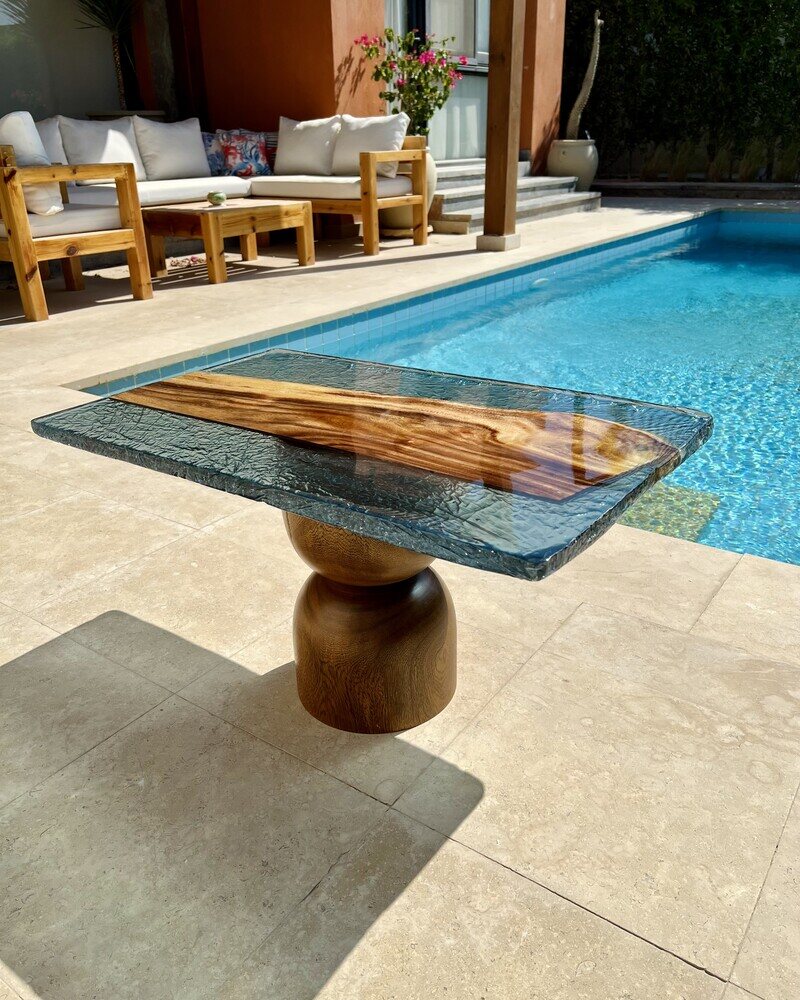
Strata
A single slab, held in still water — cast resin and walnut.
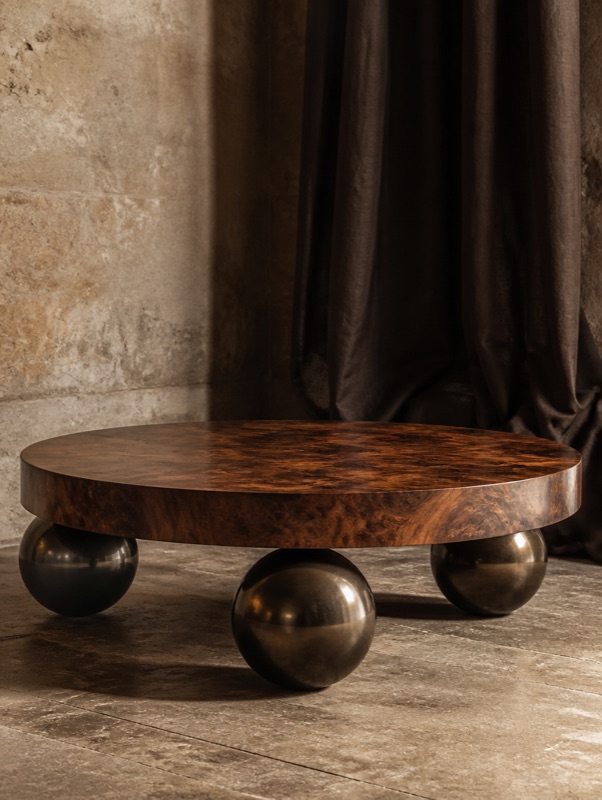
Atlas
A burled-walnut slab set down on three bronze worlds.
See the catalogue → · Each piece is one of a kind, priced on request — the honest cost breakdown is in what a river table costs.
Common questions
What is an epoxy resin table?
It is a table made by casting epoxy resin around or over a slab of solid wood, so the wood and resin cure into a single piece. The resin can be left clear to show the room through it, or tinted to add colour and light.
Are epoxy resin tables durable enough for everyday use?
Yes. A fully cured epoxy surface is hard, non-porous and water-resistant, so it shrugs off spills and daily use. It can scratch under grit and should be protected from direct heat with trivets, but with normal care it lasts for decades.
What is the difference between a resin table and a clear epoxy table?
They are the same craft. A clear epoxy table uses untinted resin so the wood and the light beneath it read through the surface, while a tinted resin table adds a colour — turquoise, amber, smoke grey — mixed to your specification.
How long does a custom resin table take to make?
At ASK the lead time is typically 6 to 12 weeks. A large part of that is the cure: a thick pour rests for roughly three weeks before the first cut, because curing the resin slowly is what keeps it clear and crack-free.
How much does a bespoke epoxy resin table cost?
Price depends on the size and rarity of the wood, the volume and tint of resin, the form, the finish and the base, so each piece is quoted individually. See our river table cost guide for the drivers and ranges, then request a quote.
Can I choose the wood and resin colour?
Yes — every table is configured with you. You choose the wood species and figure, the resin colour and opacity, the dimensions and edge, and the finish and base, all resolved in drawings before anything is cast.
Order yours
Every piece we make is one of one — shaped around your space and a slab chosen for you. An order runs six to twelve weeks and begins with a conversation; we reply within two working days.