
The resin console table, proportioned for a narrow run
A console is the one table you read standing up, in passing, against a wall — so depth, height and length decide everything. We cast each console from a single live-edge slab, with a seam slimmed to suit the proportion, and we can draw a matched pair from one flitch when a hallway calls for two.

What a console asks for that a dining table never does
A dining table is read across a room and used at arm's length; a coffee table is read from above, sitting down. A console is neither. It lives against a wall, in a route — an entryway, a hallway, the back of a sofa, the strip beneath a mirror or a wall-hung screen — and it is read standing up, in motion, mostly from the front. That changes which part of the slab matters and how the piece has to be proportioned.
The governing constraint is depth. A console has to be shallow enough not to narrow a passage or catch a hip, yet deep enough to hold a tray, a lamp and a set of keys without crowding. Length follows the wall it serves, and height is set by what hangs above — a mirror, a picture, a television. Get those three numbers right and the piece disappears into the architecture; get them wrong and a beautiful slab fights the room every day. This is a different brief from our cast-resin tables for dining and living, and we draw it from the wall outward.
Depth, height and length: scaling a console for a narrow space
Proportion is the whole craft here, because a console occupies the parts of a home where there is least room to spare. A few rules we work to, then bend for the space:
- Depth — shallow is the point. A console should leave a hallway or doorway clear to walk and stand, so we keep the front-to-back run trim and let the live edge, rather than bulk, give the piece presence.
- Height — set by use and by what hangs above. An entry console wants to meet the hand easily and sit in comfortable relation to a mirror or art; a sofa-back console is usually drawn just shy of the sofa's top rail so it reads as one composition from across the room.
- Length — governed by the wall. A long, low console can carry a generous run of slab; a short return between two doors wants a compact, contained piece that does not crowd the openings.
We model the console against your actual wall, skirting, switches, radiator and walking lines before a single cut, because in a passage a few centimetres decides whether the route flows or snags. Bring a photograph, a measurement and a sense of what will sit on it, and the geometry comes first.
A single live-edge console, or a matched pair from one flitch
Because a console is compact, it is the ideal home for one exceptional section of slab — a short length of figured flitch, a crotch with a fork in the grain, a burl offcut too special to lose to a larger top. Working from a single board keeps the live edge continuous and the grain unbroken, so the console reads as one found object set against the wall rather than a panel that was assembled.
A console is also one of the few pieces that often wants a twin. Flanking a doorway, bracketing a fireplace, or running down both sides of a hall, a matched pair only works if the two pieces share a parentage. Because we buy whole flitches and rest them for years, we can cut neighbours from the same trunk so the figure mirrors across the pair — something you cannot fake from two unrelated boards. Our live-edge work explains why owning the whole flitch is what makes a true pair, and a book-matched one, possible.
The resin seam at console scale: a slim river or a solid cast edge
At dining scale a river of resin can be broad and dramatic. On a console, the surface is narrow, so the seam has to be judged carefully — too wide and it overwhelms a shallow top; too timid and it reads as an afterthought. We tend to draw a slim river that traces a single live edge down the length of the piece, a quiet ribbon of colour rather than a wide channel, so the wood stays the subject and the resin lights it.
The alternative is a solid cast edge — resin poured to complete a single live-edge slab into a clean rectilinear top, with the natural contour submerged just under the surface or held as a crisp line along the front. That suits a console meant to sit flush and disciplined against a wall. Either way the pour is degassed under vacuum and laid in one uninterrupted session, then cured roughly three weeks before the first cut, so it finishes glass-clear and free of trapped air. For how the colour itself behaves — clear as water, smoked sea-glass, or a saturated jewel tone — see our guide to resin colours and tints, each mixed once and never repeated.
Choosing wood for a piece seen up close
A console is passed within touching distance many times a day, and often paused at — keys set down, a coat shrugged off, a glance in the mirror. That proximity rewards wood with figure that holds a close, lingering gaze, where a dining top a few metres off might want something calmer. The species choice is the larger half of the decision:
- Burled walnut — swirling, knotted figure and warm chocolate tones; mesmerising at arm's length, the classic choice when you want the grain to be the event.
- Ziricote — dramatic black landscape-grain on a brown ground; architectural and formal, at home in a hard-edged hallway.
- Macassar ebony — fine dark-and-amber stripes that read like a pinstripe up close; quiet from across the room, unmistakably rare in the hand.
- Olive — pale gold with restless, lively figure; bright rather than sombre, good where a passage needs lifting.
Each takes oil and lacquer differently and suits a different light, so we guide the choice around your wall, your daylight and what hangs above. Our notes on the best wood set out how each species behaves under tool and finish, and the same logic applies to a console — only read more closely.
Bases: blackened steel, bronzed frames and floating shelves
On a console the base does real visual work, because the piece is seen in profile and from the front as you approach. We treat it as part of the composition, not an afterthought.
A slim steel or bronzed frame lifts the slab and lets light pass beneath, so a shallow console reads light against the wall rather than blocky. Splayed or A-frame legs suit a freestanding entry console; a clean rectangular frame suits a disciplined, architectural run. A floating, wall-mounted console removes legs altogether — the slab appears to grow from the wall, which keeps a tight hallway clear underfoot and is the most space-generous option of all, where the wall construction allows it. A sculpted timber plinth is the third route, grounding the piece and tying it to the wood above. We choose visual weight to match the slab: a thick top wants a recessive base; a slender one can carry something more sculptural.
Styling a console: what sits on it, and what hangs above
A console is a stage, and a narrow one, so what it holds is part of the design from the start. We draw the height and length knowing whether a mirror, a picture or a television will sit above it — the surface and the thing on the wall should read as a single composition, with the console's resin or figure echoing, not fighting, what hangs over it. Below, a console invites the daily objects of an entrance: a lamp, a low bowl, a stack of books, a tray for keys, perhaps a single sculptural piece. We keep the depth honest about that load so the surface never feels cramped.
It need not stand alone, either. Because we cut from whole flitches, a console can echo a larger piece elsewhere in the home — a feature wall, a pivot door, or a wall piece drawn from the same flitch and the same pigment batch, so the materials speak to each other down a hallway. Bring photographs, swatches and the wall's dimensions, and we design the console into the route rather than onto it.
Lead time, delivery and how we work
Every console is made to order in our atelier on the Red Sea coast and delivered worldwide — to private residences, yachts and hospitality projects. An order runs six to twelve weeks: the resin alone cures roughly three weeks before the first cut, and we will not rush that. Each order begins with a conversation, and we reply to inquiries within two working days.
Before anything is made, we approve the piece together as drawings and sample resin pours, so you see the proportion against your wall and the colour in your light before a slab is committed. We never quote from a list — a console's compact footprint usually makes it one of the more accessible ways to own a cast piece, but cost still follows the rarity of the slab, the finish, the base and shipping. When you are ready, start the conversation and we will draw it from your wall outward.
From the catalogue
Pieces from the atelier in this direction — each made to order, each with its own page.
 № 07 · Coffee table
Atlas
A burled-walnut top set down on three polished bronze spheres — figure that rewards arm’s length.
 № 05 · Pivot door
Carmine
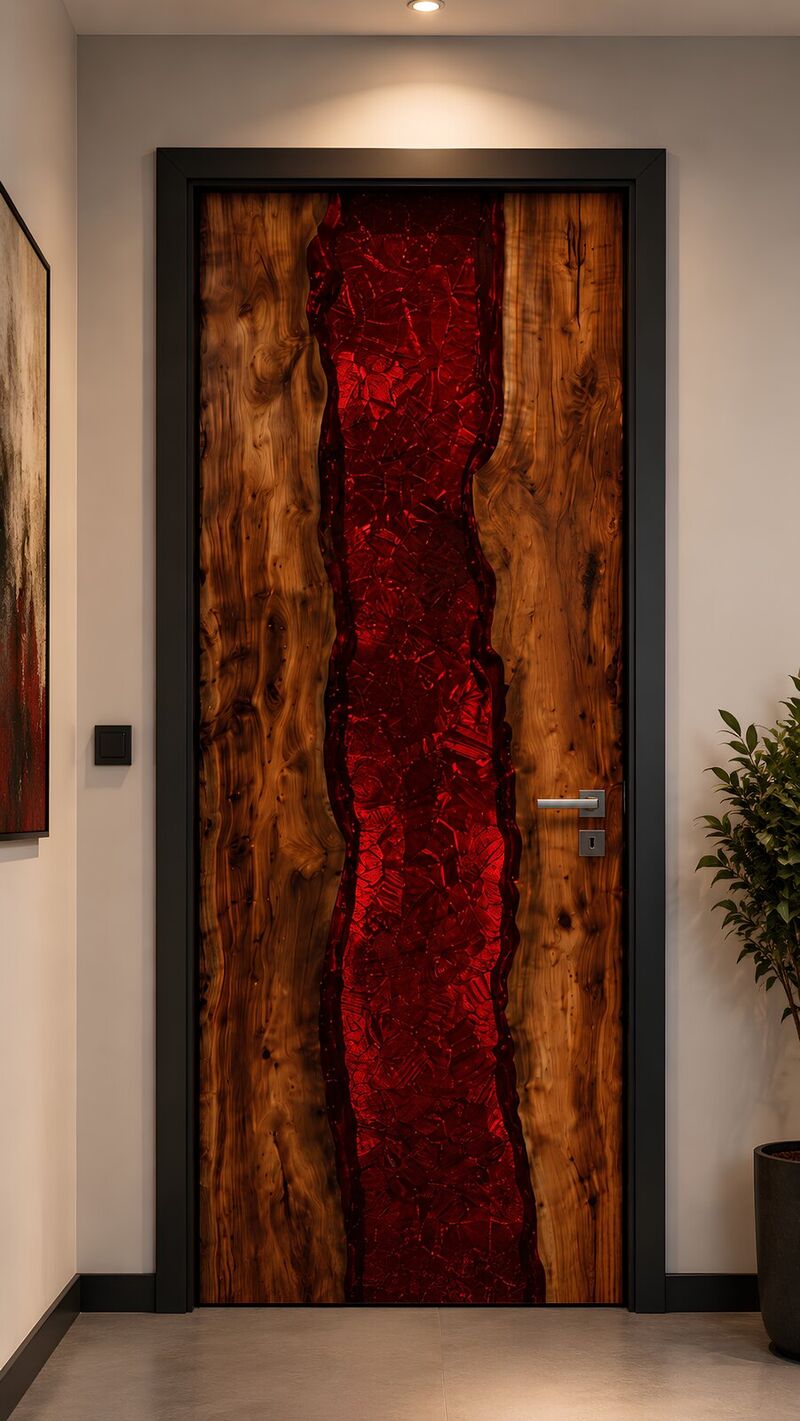
Walnut burl split by a garnet cast-resin river — an entrance made to be paused at.
See the catalogue → · Each piece is one of a kind, priced on request — the honest cost breakdown is in what a river table costs.
Common questions
What is a resin console table?
It is a narrow, wall-set table made by casting tinted epoxy resin together with a slab of solid wood — usually as a slim translucent seam tracing a live edge, or as a solid cast edge that completes the top. Because it lives in a passage and is read standing up, its depth, height and length matter more than on any other table, and the wood's figure carries the piece up close.
How deep should a console table be for a hallway or entryway?
Shallow enough to leave the route clear to walk and stand, yet deep enough to hold a lamp, a tray and keys without crowding — the exact figure depends on the width of your passage. We model each console against your actual wall, skirting and walking lines before cutting, because in a narrow space a few centimetres decides whether the room flows or snags.
Can you make a matched pair of console tables from the same wood?
Yes. Because we buy whole flitches and rest them for years, we can cut two consoles from neighbours in the same trunk so the figure mirrors across the pair — ideal for flanking a doorway or running down both sides of a hall. A true matched or book-matched pair cannot be faked from two unrelated boards, which is exactly why working from one flitch matters.
Should a console table have a live-edge seam or a solid cast top?
On a narrow top we usually draw a slim river — a quiet ribbon of resin tracing one live edge — so the wood stays the subject. The alternative is a solid cast edge, where resin completes a single slab into a clean rectilinear top that sits disciplined against a wall. Both are degassed and poured in one session; which suits you depends on whether you want the console soft and organic or crisp and architectural.
What height should a console table be under a mirror or television?
It is set by what hangs above and how the piece is used. An entry console under a mirror wants to meet the hand easily and sit in comfortable relation to the glass; a sofa-back console is usually drawn just shy of the sofa's top rail so the two read as one composition. We draw the height knowing what will sit above, so the surface and the wall piece read together rather than fighting.
How long does a bespoke resin console table take, and do you deliver worldwide?
Six to twelve weeks. The resin alone cures about three weeks before the first cut, and the wood is chosen from flitches we have rested for years. Every piece is made to order in Egypt, approved first as drawings and sample pours, then crated and delivered worldwide. We reply to inquiries within two working days.
Order yours
Every console we make is one of one — sized to your hallway, entrance or wall and cut from a slab chosen for you. An order runs six to twelve weeks and begins with a conversation; we reply within two working days.
Start the conversation WhatsApp the atelier Email the studio See the catalogue