
Resin wall art, doors, screens and dividers
Resin does not stop at the tabletop. We cast resin wall art and architectural pieces — feature walls, pivot doors, folding screens and room dividers — for private residences, yachts and hospitality spaces worldwide.

Epoxy wall art that reads as architecture
A table is furniture; a wall is the room itself. When resin moves vertical it stops being an object you gather around and becomes a surface you live against — which changes everything about how it is conceived. Ondine, our walnut and pale-green resin feature wall, was composed the way a painting is hung: book-matched grain reading left to right, the resin river placed to catch the light a room actually receives at the hours it is used.
This is the same craft as our cast-resin tables — whole flitches of rare wood, pigment mixed once and never repeated, a single uninterrupted pour cured for weeks — turned to a different scale and a different plane. The discipline does not loosen because it leaves the floor. If anything a wall is less forgiving: at eye level, in daily light, every seam and every shift in colour is read closely and read often.
The resin door: pivot, weight and one continuous pour
A resin door is the most demanding thing we make on a wall. Carmine — a pivot door of red resin set into burled walnut — has to behave as joinery and as art at once: it must swing true on its pivot for years, and it must look poured-in-place rather than panelled-on. We resolve that by treating the leaf as a single composition, casting so the resin reads continuously across the face rather than as an inlay dropped into a frame.
Weight and balance are designed, not discovered. An epoxy pivot door carries real mass, so the pivot hardware, the floor and ceiling fixings and the swing arc are engineered alongside the artwork, not after it. Burl and figured grain are chosen for movement as well as beauty — a door flexes with a building's seasons more than a tabletop ever will, and the wood is selected and rested to take that calmly.
Folding screens and room dividers: light you can move
Freestanding pieces let resin do what it does best — pass light. Vanta is a four-panel folding screen in black woven twill and amber resin; Levante is a room divider that washes from Mediterranean turquoise to Red Sea gold in resin and steel. Both are screens in the truest sense: they filter a room rather than seal it, glowing where light strikes the cast resin and falling to shadow in the solid.
A resin folding screen and a resin room divider answer different problems. A screen is hinged, portable, and rearranges a space at will — ideal where a room must change through the day. A divider is fixed, structural, and defines two zones permanently. We will steer you to the right one early, because hinge geometry, panel weight and how much light each panel should pass are decisions that shape the whole order.
- Folding screen — hinged, movable, freestanding; sculptural and reconfigurable.
- Room divider — fixed or floor-to-ceiling; spatial and architectural.
Scale, mounting and the engineering behind the glow
Large resin panels are heavy, and how a piece meets the building is half the work. A resin feature wall is rarely one monolith; we plan panelisation, concealed cleats or sub-frames, and substrate so the surface stays flat and the joints read as intention rather than accident. For ceilings, pivots and freestanding screens, the hidden steel and hardware are detailed to the millimetre.
Light is the material's collaborator. Cast resin is translucent, so a piece changes completely between front lighting, raking light and backlighting — the trick we used in the backlit island of our Halcyon kitchen. We design for the light a room genuinely has, and where wanted we integrate concealed LED so a wall or divider can glow on its own after dark. Tell us the wall, the sightlines and the light, and the piece is composed to them.
For residences, yachts and hospitality
Architectural resin suits the places that ask the most of a surface. In private residences, a pivot door or feature wall becomes the one piece a house is remembered by. On yachts, where weight, motion and humidity rule, we engineer panels and screens to be light, secured and stable at sea — the same discipline that shapes our yacht furniture, where material choices and fixings change accordingly. In hospitality, a resin room divider or screen gives a lobby, restaurant or suite a signature that photographs and lasts under daily use.
Each piece is made to order in Egypt and delivered worldwide, with crating and installation guidance suited to the site. Because the work is architectural, the earlier we are in the conversation — alongside the architect or designer — the better the result. Lead times run roughly six to twelve weeks depending on scale and finish. To begin, start the conversation with your wall, your plan and your light.
From the catalogue
Pieces from the atelier in this direction — each made to order, each with its own page.
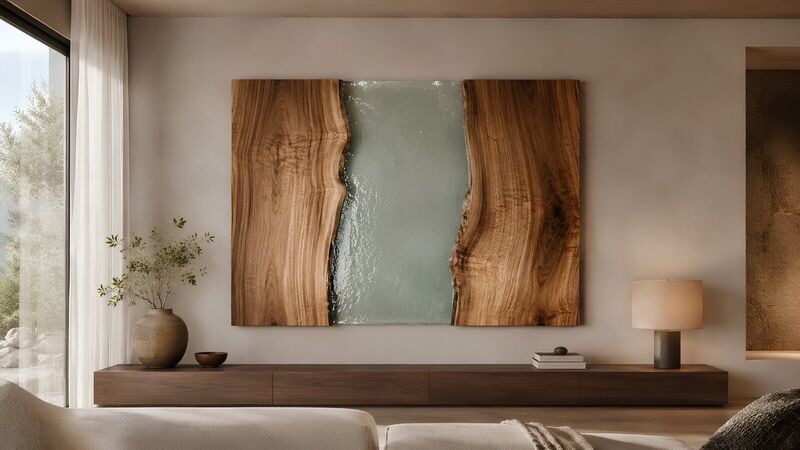 Cast resin · Walnut
Ondine
A river, raised to the wall.
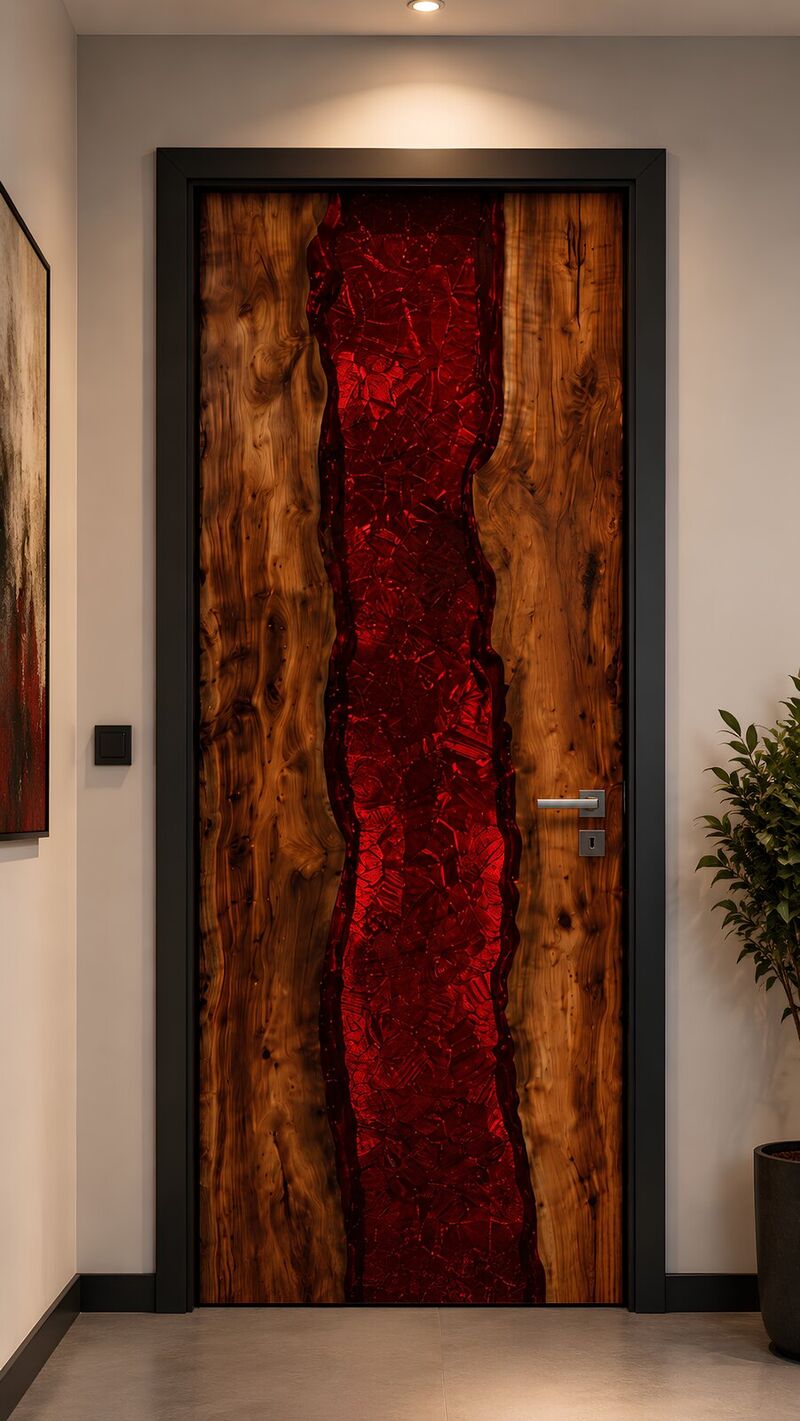 Cast resin · Walnut burl
Carmine
A garnet seam, hinged.
See the catalogue → · Each piece is one of a kind, priced on request — the honest cost breakdown is in what a river table costs.
Common questions
What is resin wall art?
Resin wall art is architectural cast-resin work made for walls and rooms rather than tabletops — feature walls, pivot doors, folding screens and room dividers in which translucent epoxy resin is poured into rare wood, twill or steel. It behaves as architecture and as art at once, glowing where light passes through the cast resin.
Can you make an epoxy pivot door?
Yes. A resin pivot door, like our Carmine piece, is cast as a single continuous composition in figured wood and engineered as joinery — the pivot hardware, weight and swing arc are designed alongside the artwork so it both opens true and reads as poured in place.
What is the difference between a resin folding screen and a resin room divider?
A folding screen is hinged, freestanding and movable, so it can rearrange a space through the day; a room divider is fixed or floor-to-ceiling and defines two zones permanently. We help you choose early because hinge geometry, panel weight and light differ between them.
Can a resin feature wall be backlit?
Yes. Cast resin is translucent, so a feature wall or divider changes completely with front, raking or back lighting. Where wanted we integrate concealed LED so the piece glows on its own after dark, as in the backlit island of our Halcyon kitchen.
Do you make resin pieces for yachts and hospitality projects?
We do. For yachts we engineer panels and screens to be light, secured and stable against motion and humidity; for hospitality we make resin dividers and feature walls that give a space a signature and withstand daily use. Every piece is made to order in Egypt and delivered worldwide.
How large can a resin wall panel be?
Large pieces are panelised rather than cast as one monolith, with concealed cleats or sub-frames keeping the surface flat and the joints intentional. There is no fixed limit — scale is resolved per site, alongside mounting and the light the room receives.
Order yours
Every piece we make is one of one — shaped around your space and a slab chosen for you. An order runs six to twelve weeks and begins with a conversation; we reply within two working days.
Start the conversation WhatsApp the atelier Email the studio See the catalogue